Question-Driven Weed Science: EWRS 2026 Webinar Series – Part I
Organized by EWRS WG 'Education and Training' involving other EWRS WGs
online, 24th of February to 26th of March 2026
What do young researchers miss in their education in weed science? Instead of making assumptions, this webinar series was developed by asking them directly.
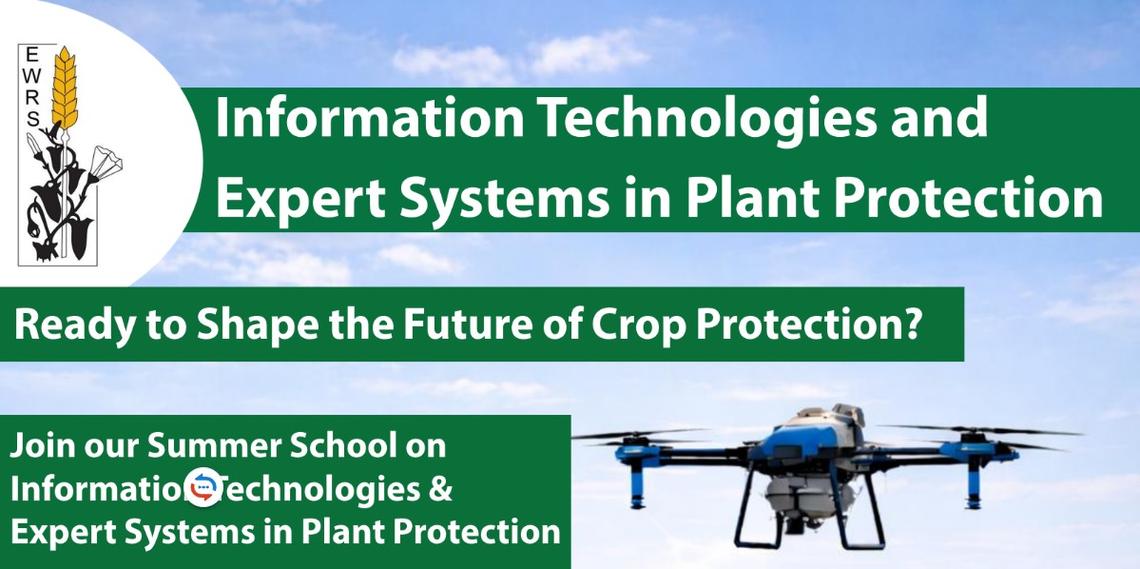
What do young researchers miss in their education in weed science? Instead of making assumptions, this webinar series was developed by asking them directly. Based on a survey conducted among young researchers across Europe, key questions, challenges, and topics were identified that are rarely addressed in traditional programmes. Organized by the WG Education & Training, the webinar series is aimed at researchers and colleagues interested in gaining a better understanding of research processes in weed science, from conceptual and theoretical perspectives to experimental approaches. The webinars encourage direct interaction, giving participants the opportunity to ask questions and discuss topics that are often missing from standard training. This is the first webinar cycle, with a second cycle planned for autumn.
For further information please contact Aleksandra Savić (aleksandra.m.savic@gmail.com). Registration details and the course sign-up link are available HERE.
While registration is open to everyone, each webinar can accommodate up to 100 participants.
- Invasive alien plants in a changing world
February 24, 2026 (14–15:30) (Central European Time, CET)
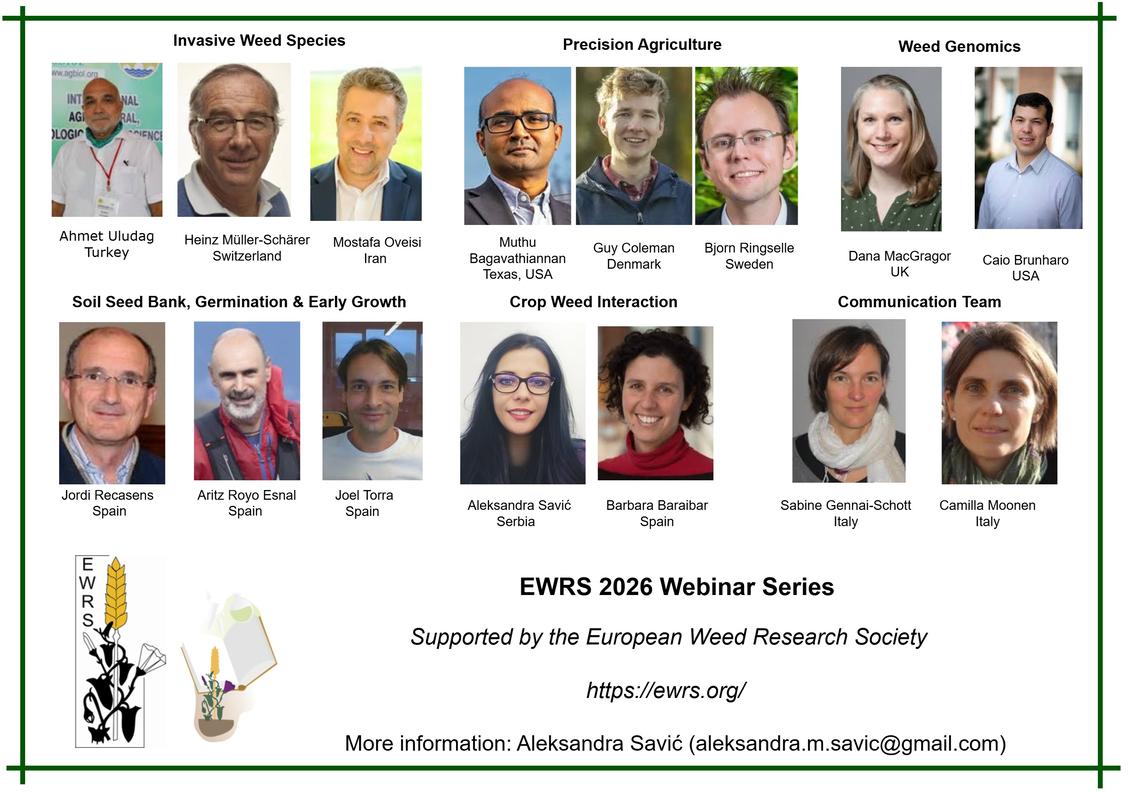
Speakers: Ahmed Uludag, Heinz Müller-Schärer and Mostafa Oveisi
The webinar focuses on invasive alien plant species under conditions of climate change. It addresses concepts of invasiveness and pathways of plant introduction, together with an analysis of their increasing occurrence and effects on biodiversity and ecosystems. Particular attention is given to explaining why plant species that are often rare in their native range become invasive after introduction, as well as to the influence of climate change on their performance relative to native species. The webinar also considers the limitations and challenges of managing invasive alien plants across different habitat types and presents spatial modelling approaches for predicting the potential distribution of invasive plant species based on various data sources and climate scenarios. For more information, please follow the link below: https://www.unifr.ch/bio/en/assets/public/Research/Heinz-Mueller-Schaerer/publications/2026/IAP%20overview.pdf
2. Soil seed bank to seedling: Assessment and management of early growth stages of weeds
March 3, 2026 (14–15:30) (Central European Time, CET)
Speakers: Aritz Royo Esnal, Joel Torra Farré and Jordi Recasens Guinjuan
The webinar will begin with the concept of the soil seed bank and its dynamics, as well as the biotic and abiotic factors that affect the entire process from dormancy release to emergence, the need to adjust field management to the soil seed bank community, and methods for sampling it. Part of the lecture will focus on the development of models that contribute to predicting growth stages, from simple ones, such as emergence and early growth models, to more elaborated population dynamic models. The webinar will also focus on mid- to long-term strategies for reducing the soil seed bank of different weed species populations, taking into account their dormancy and germination characteristics.
3. Modern genomics for non‑model weeds
March 10, 2026 (14–15:30) (Central European Time, CET)
Speakers: Dana MacGregor and Caio Brunharo
This webinar offers a concise, practical overview of genetic and genomic tools used in modern weed ecology. Topics include population genomics, genetic mapping of key traits, and integrating gene expression and plant chemistry to understand ecological performance. The content is anchored in examples from recent studies and community datasets, showing how analyses are carried out in practice and how experiments are designed.
4. Crop–weed competition: mechanisms, methods and experiences from experimental research
March 17, 2026 (14–15:30) (Central European Time, CET)
Speakers: Aleksandra Savić and Bàrbara Baraibar Padró
The lecture provides an overview of crop–weed competition through the mechanisms that determine the outcomes of interactions. Emphasis is placed on early stages of plant development, spatial organization of plants, and belowground processes that directly influence the intensity and direction of competition. A dedicated part of the lecture focuses on methods used to study competition, including the selection of experimental designs, manipulation of plant density and spatial arrangement, and approaches for measuring competitive effects. The lecture links competitive mechanisms with the methods used to study them and with concrete experience gained through experimental research.
5. Exploring precision technologies for weed management
March 26, 2026 (14–15:30) (Central European Time, CET)
Speakers: Muthu Bagavathiannan, Guy Coleman and Björn Ringselle
Precision technologies are rapidly transforming how weeds are detected, monitored, and managed across agricultural systems. Advances in sensing platforms, data analytics, and artificial intelligence are enabling more targeted, data-driven approaches that move beyond uniform field-scale interventions. This webinar will examine the evolving landscape of precision weed management, emphasizing how emerging digital tools are reshaping decision-making, improving efficiency, and supporting more sustainable weed control strategies. Discussion will address the integration of aerial and ground-based sensing, the growing importance of shared data resources and interoperable frameworks, and the expanding role of machine learning in understanding weed-crop interactions. Broader implications for biomass estimation, phenotyping, and weed ecology will also be considered, along with challenges related to scalability, adoption, and weed adaptation in increasingly precise agricultural systems. Together, these perspectives will highlight both the opportunities and the complexities of applying precision technologies to real-world weed management.